Disclaimer: This page may contain affiliate links. I may earn a small commission if you book or purchase through them, at no extra cost to you. Please read my Privacy Policy for more information. Thank you!
Let’s be honest. If you have searched “Japan itinerary,” you have probably seen the same three cities appear over and over again: Tokyo, Kyoto, Osaka.
And while they absolutely deserve the hype, there comes a point when you are shoulder to shoulder at Fushimi Inari wondering if you accidentally signed up for a marathon instead of a shrine visit.
That was when I realised there had to be hidden gems in Japan, like lesser-known places that were just as interesting, but far less crowded.
If you are searching for off the beaten path Japan destinations, you are probably not trying to avoid people entirely.
You simply want somewhere that feels more relaxed, more local, and easier to explore at yourown pace.
For me, “off the beaten path” doesn’t mean remote villages that require three domestic flights and a ferry.
It means places that still feel authentic and culturally rich, but without the constant tour group choreography.
After two trips to Japan, including a 3-week journey beyond the main tourist cities, I found that some of my most memorable moments happened in smaller towns, mountain onsen villages, and historic districts where I did not need to plan my movements around tour groups.
In this guide, I am sharing a curated collection of destinations across Japan that offer a different rhythm from the usual itinerary.
Some are genuinely less visited by international travelers. Others are simply calmer alternatives that still fit beautifully into a first- or second-time Japan itinerary.
Most of the destinations below are places I’ve personally visited across two trips to Japan.
I’ve also included a few that are high on my own list for next time, especially if I have a bit more time to explore.
Let’s get into it!
Extra note: Not sure which of these actually fit your route? I made a quick, fun-to-use checker below to help you narrow it down 🙂
Hokkaido Region
1. Hokkaido
If your idea of Japan leans more toward dramatic landscapes than temple hopping, Hokkaido is where the scenery shifts completely.
Instead of dense historic districts, you’ll find national parks, volcanic terrain, alpine mountains, and wide-open coastlines on this Japan’s northernmost island.
Shiretoko and Daisetsuzan are often highlighted for hiking and raw landscapes, while Mount Usu near Lake Toya offers volcanic views without committing to a full mountain climb.
In winter, Niseko and Furano become ski destinations, and Sapporo comes alive during the Snow Festival.


That said, Hokkaido isn’t a quick detour you casually squeeze in between Kyoto and Osaka.
You’ll want to dedicate at least 4 to 5 days and are comfortable flying north from Tokyo into Sapporo.
So if you’re planning a short first trip to Japan, it may stretch your route too far.
With that said, Hokkaido stands apart from central Japan, especially if wide landscapes and nature-focused days are what you’re craving.
Tohoku Region
2. Akita
Akita rarely makes it onto first-time Japan itineraries, and that’s precisely what makes it appealing if you’re craving something quieter and more rural.
The area is best known for Nyuto Onsen, a collection of traditional hot spring ryokans tucked into the mountains.
Tsurunoyu Onsen, with over 300 years of history, is the most iconic of the group and is especially popular in winter when the outdoor baths are surrounded by snow.
Lake Tazawa, Japan’s deepest lake, offers scenic views and a slower pace, while Mount Akita-Komagatake attracts hikers, particularly during autumn when the foliage turns vibrant.
Kakunodate provides a preserved samurai district similar in concept to Kanazawa’s historic areas, but on a smaller and quieter scale. Some of the former residences are open to visitors, and the town is especially known for cherry blossom season in spring.
If you’re in Akita City in summer, the Kanto Matsuri is one of the region’s most distinctive summer festivals.
Performers balance long bamboo poles lined with lanterns on their shoulders and foreheads, which makes it visually impressive without feeling overly commercial.


Because of its location, Akita works best as part of a broader Tohoku exploration rather than a quick detour from Tokyo or Kyoto.
Getting here takes time and planning, so it’s better suited for longer trips when you can move slowly through the region and experience a more seasonal, rural side of Japan.
Hokuriku Region
3. Kanazawa
Kanazawa was one of the first less crowded places in Japan I added into my Japan itinerary, and it definitely didn’t disappoint.
Often described as a calmer alternative to Kyoto, Kanazawa offers preserved districts, traditional architecture, and cultural depth without the huge crowds of visitors.
The lovely city is home to Kenrokuen, one of Japan’s most famous landscape gardens, along with Kanazawa Castle Park just right next door.
You can easily spend a full quiet morning in this area without needing to rush between sights!
The Nagamachi Samurai District gives you that preserved Edo-period atmosphere, while Higashi Chaya District offers a glimpse into Kanazawa’s historic teahouse culture.
There’s also Myoryuji Temple (often called the “Ninja Temple”), known for its hidden staircases and trap mechanisms, offers something a little different from the typical temple visit!
Travel tip: Myoryuji requires advance reservation for its guided tour, so plan ahead if you want to visit.

🤪

Food-wise, Omicho Market is an easy stop for fresh seafood, and yes, gold-leaf ice cream is a fun novelty here 😅
While Kanazawa can technically be done as a day trip from Takayama, I wouldn’t recommend it.
There’s enough things to do to comfortably fill 1 to 2 nights, and staying overnight or longer allows you to visit Kenrokuen early and check out the historic districts and other sights at a more relaxed pace.
So if you’re building a multi-city Japan itinerary and want something culturally rich without adding another high-density stop, Kanazawa fits naturally between Tokyo and the Japanese Alps.
Chubu Region
4. Matsumoto
If you want to see one of Japan’s original castles without the scale and bus-tour energy of Himeji, Matsumoto is a strong contender.
Compact, easy to walk, and framed by the Northern Alps, the city feels relaxed without being sleepy.
It works especially well if you’re already traveling between Hirayu Onsen and Tokyo.
The main draw is Matsumoto Castle, one of the 12 remaining original castles in Japan. From the outside, the black-and-white exterior reflected in the moat is striking.
Inside, the steep wooden stairs are no joke, but climbing to the top gives you stunning views over the city with mountains in the distance.
Travel tip: The stairs inside Matsumoto Castle are steeper than they look in photos. Wear shoes that are easy to remove and put back on, and avoid skirts if possible since some sections are narrow and crowded. If you want a smoother experience, arrive earlier in the morning before kids school groups rotate through.


Here are some of the other main highlights in Matsumoto:
- Nawate Street (Frog Street): A short riverside stretch with quirky shops and snacks. It’s low-key and easy to explore in under an hour.
- Nakamachi Street: White kura storehouses turned into cafes and boutiques. A nice place to slow down between sightseeing.
- Yohashira Shrine: Small and peaceful.
- Matsumoto Art Museum: Especially worth a stop if you’re interested in the artist Yayoi Kusama
Unlike Osaka, Matsumoto isn’t packed with headline attractions, and that’s actually part of its appeal. Two nights felt comfortable, especially if you want time to explore at a slower pace without cramming in day trips to Narai-juku or Nagano.
So if you’re already moving through the Japanese Alps and don’t want to go out of your way for a castle stop, Matsumoto fits naturally into the route.
5. Takayama
Takayama slots in easily after Kanazawa, especially if you’re continuing toward the Japanese Alps.
I’ve visited Takayama on both of my trips to Japan, and yes, it’s busier now than it used to be. The Old Town area, especially Sanmachi Street, sees a steady flow of day-trippers from Kanazawa and Shirakawago.

The preserved wooden merchant houses, sake breweries with cedar balls hanging outside, and narrow lanes still make it one of the most atmospheric towns in the region.
If you want to really enjoy that slower, old-Japan feel, go early. Around 7 or 8am, the streets are quiet enough to wander without bumping into tour groups.
Once the main street starts getting busy, head toward theHigashiyama Walking Course instead.
The temple paths there is definitely calmer and far removed from the souvenir-shop buzz in the center.
The Yatai Kaikan (Festival Float Exhibition Hall) is another solid detour. It gives helpful context to Takayama’s famous festivals, and it’s usually much quieter than the Old Town strip.
Here are some other worthwhile stops in Takayama:
Hida no Sato: An open-air museum showcasing traditional gassho-zukuri houses. A good alternative if you want to see this architectural style without the heavier crowds of Shirakawago.
Miyagawa Morning Market: A small riverside market selling local produce, souvenirs, and simple snacks.
Sample local sake: Several breweries offer tastings, and some even have vending machines where you can try a cup for around 200 yen. It’s an easy, affordable way to compare flavors.


With that, I still recommend Takayama for first-time travelers who enjoy traditional architecture and small-town character.
Personally, I’d spend two days here to explore at a more relaxed pace rather than rushing through as a day trip.
Travel tip: Stay near Takayama Station. It makes arrival and departure easier, especially if you’re taking buses to Shirakawago or Hirayu Onsen and don’t want to drag luggage across town.
6. Hirayu Onsen
Instead of jumping straight from one sightseeing-heavy town to another, adding Hirayu Onsen gives you a proper reset in the middle of the mountains in the Japanese Alps.
The main focus here is the onsen experience.
Most accommodations are traditional ryokans with indoor and outdoor baths, and one night is usually enough to enjoy it without feeling rushed.
I visited in early winter and stayed at Tsuyukusa for two nights. Soaking in the outdoor bath while snow was falling around me was easily one of the most memorable moments of the entire trip!
Winter adds a magical atmosphere, but it also means some outdoor facilities and trails may be closed due to snow.
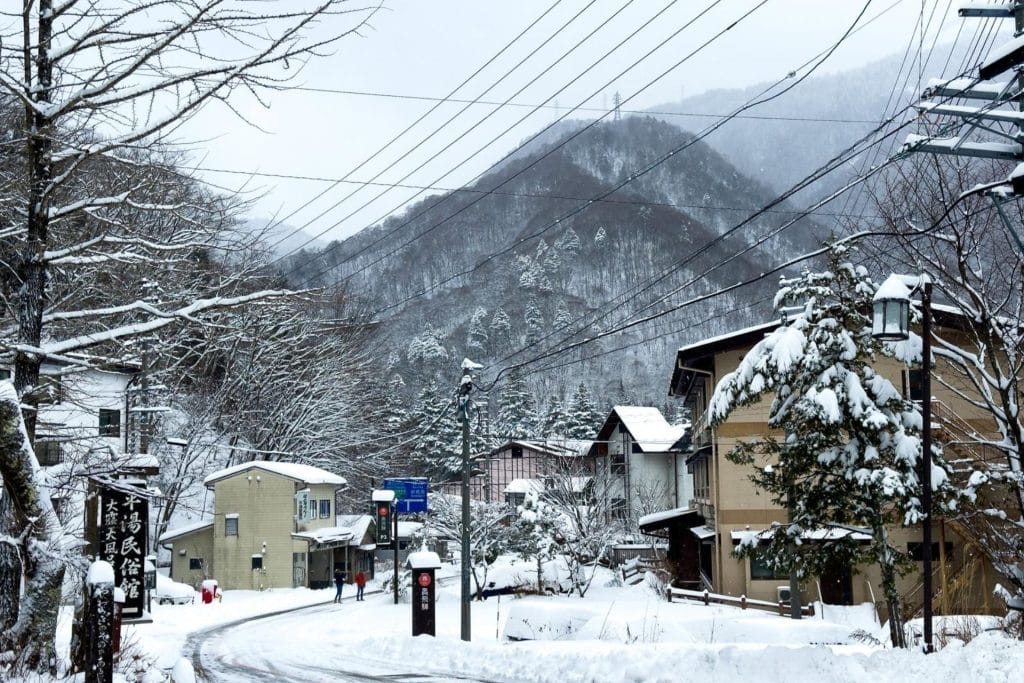

Aside from onsen soaking, here are a few things you can do:
- Hirayu no Mori: A public bath complex with multiple outdoor pools surrounded by forest, great if you want more variety beyond your ryokan’s baths.
- Shinhotaka Ropeway: About 30 minutes away by bus. You take a double-decker gondola up into the mountains for panoramic Alpine views. I went during heavy snow and visibility was low, but the snow-covered trees alone made it worthwhile!
- Hirayu Otaki Waterfall: One of the tallest waterfalls in the region. In winter, parts of it freeze, which makes it especially striking.
- Kamikochi (seasonal): From spring to autumn, Hirayu works as a convenient base for hiking in Kamikochi.
Since Hirayu Onsen is a small town, there are some practical things to keep in mind: dinner options are limited, and there’s no major convenience store in town, so plan meals ahead if you’re arriving late. Also, English is also less widely spoken compared to larger cities, so having Google Translate ready can help.
7. Narai-juku
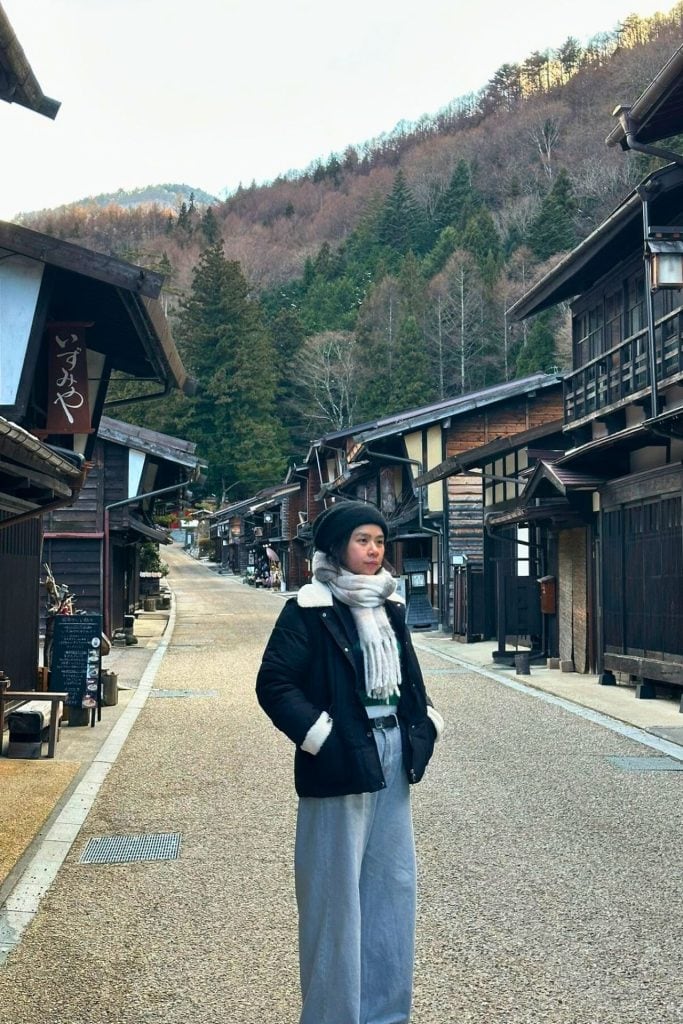
Narai-juku is one of the best-preserved post towns along the old Nakasendo Trail, the historic route that once connected Edo (now Tokyo) to Kyoto.
The moment you step onto its main street, lined with wooden shophouses and traditional facades, the atmosphere shifts completely. It feels like stepping into a different era.
When I visited on a weekday in early winter, Narai-juku was so quiet, and for a brief moment, I felt like the I had somehow arrived on an unofficial “everyone stay home” day.


To a point that I even considered leaving early because there were barely any visitors which, in hindsight, is ironic, because that quiet is exactly the point!
That said, there are a few stops worth visiting:
- Nakamura Residence (known for its comb collection)
- Kiso-no-Hashi Bridge
- Shizume Shrine
- Hirodensandaiho Temple
- A short stroll along the cedar-lined section of the old trail
You can also try local specialties like Toji soba or Gohei-mochi while you’re there.
Narai-juku works well as a half-day or relaxed day trip from Matsumoto (about 45 to 60 minutes by train).
The town itself is essentially one long preserved street, so you don’t need a complex route, just start at one end and walk through at your own pace.
So if you’re expecting high-energy sightseeing, this may feel too slow.
But if you want a quieter contrast to cities like Tokyo or Kyoto without drastically changing your route, it’s definitely an easy addition.
Kansai Region
8. Koyasan
If you’re looking for something spiritually immersive rather than visually impressive, Koyasan offers a completely different side of Japan.
Located in the mountains of Wakayama Prefecture, Koyasan is the center of Shingon Buddhism and best known for its temple lodgings.
Instead of neon signs and food streets, you’ll find moss-covered paths, lantern-lit walkways, and temple compounds that feel removed from the usual city vibes.
One of the main reasons people visit Koyasan is to stay overnight in a shukubo (temple lodging).
Guests can experience vegetarian Buddhist meals (shojin ryori), early morning prayer ceremonies, and a slower daily routine that feels intentional rather than rushed.
Okunoin Cemetery is another main highlight. It’s one of Japan’s most sacred sites, with thousands of stone lanterns and towering cedar trees lining the pathway.
The best time to visit the site in the late afternoon, when the light filters through the cedar trees and the stone lanterns begin to glow softly along the path.

That said, Koyasanisn’t the easiest place to squeeze into a tight itinerary.
Getting there involves multiple train transfers and a cable car, so I recommend dedicating at least one night rather than attempting a rushed day trip from Osaka.
9. Ine
Among the non-touristy places in Kyoto that are still accessible without a domestic flight, Ine offers a completely different side of the region that most first-time visitors never see.
Instead of temple gates and stone lanterns, the village is defined by rows of traditional funaya—wooden boat houses built right along the water.
The ground level stores fishing boats, while the upper floors serve as living quarters.
It’s a layout shaped by necessity rather than tourism, and that authenticity is what makes it stand out among off-the-beaten-path Japan destinations!


There isn’t a checklist of major attractions here. The experience is simple: walk along the harbor, watch local fishermen head out to sea, and notice how slowly everything moves compared to Kyoto.
For a different perspective, I’d recommend taking the short boat cruise.
From the water, you can see the full row of funaya backed by green hills; a view that feels completely different from walking the harbor at street level.
Because Ine sits along Kyoto’s northern coastline, getting there requires a bit of planning.
Most travelers combine it with Amanohashidate for a half-day visit, though staying overnight in a converted funaya guesthouse offers a much quieter experience once day-trippers leave.
Chugoku Region
10. Kurashiki
Kurashiki is one of those underrated destinations in Japan that carries an old-school charm but without the overwhelming crowds of Kyoto.
Located in Okayama Prefecture,Kurashiki’s Bikan Historical Quarter is what draws most visitors here.
Its white-walled storehouses and willow-lined canal feel meticulously preserved, yet the area remains lived-in rather than museum-like.

Unlike larger historic quarters, Kurashiki is compact. You can explore it comfortably in a few hours without feeling rushed.
The canal-side stroll is the highlight, and short boat rides operate during the day if you’d like to see the town from the water.
It’s the kind of place where you think you’ll spend 45 minutes… and suddenly it’s been three hours and you’re still wandering slowly along the water 😅
Beyond the scenery, Kurashiki is also home to the Ohara Museum of Art, Japan’s first museum of Western art, which adds cultural depth beyond just “pretty streets.”
Kurashiki works particularly well as a slower alternative if you’re already visiting Hiroshima or Okayama.
Shikoku Region
11. Matsuyama
Matsuyama is one of the more overlooked cities in Shikoku, yet it offers a surprisingly balanced mix of history, views, and classic onsen culture.
The city’s main landmark is Matsuyama Castle, one of Japan’s original surviving castles.
Perched on a hilltop, it requires either a ropeway ride or a short uphill walk to reach the entrance.
The reward is panoramic views over the Seto Inland Sea and the surrounding city—a perspective that feels very different from castle towns on the mainland!

At the base of the hill sits Dogo Onsen, one of Japan’s oldest hot spring baths.
The wooden bathhouse building is instantly recognizable and has long been associated with traditional bath culture in Japan.
Even if you don’t plan to soak, the surrounding Dogo Onsen shopping street is worth wandering for local snacks and small shops.
Matsuyama isn’t usually included in first-time itineraries, partly because reaching Shikoku requires a bit more intention.
It makes the most sense if you’re already exploring western Japan, pairing naturally with places like Hiroshima or taking the Shimanami Kaido cycling route.
You can comfortably cover the main sights in one to two days, without feeling like you’re rushing from one thing to the next!
12. Naoshima
Naoshima feels nothing like the Japan most first-time visitors imagine.
Instead of temples or castle towns, this small island in the Seto Inland Sea is known for contemporary art museums, outdoor installations, and minimalist architecture set against coastal scenery.
It’s one of the more unique places to visit in Japan if you’re looking to add something visually different to your itinerary.
The island is home to several well-known museums, including the Chichu Art Museum and Benesse House, where art, architecture, and landscape are intentionally blended together.
Even if you’re not deeply into modern art, the way the buildings interact with light and space makes the experience more immersive than a typical gallery visit.


✨
With that said, Naoshima works best as an overnight stay rather than a rushed day trip.
Ferry schedules, museum time slots, and bike rentals require a bit of coordination, so giving yourself more time allows you to explore at a slower pace and actually soak in the island’s artistic atmosphere.
You can combine it with a Hiroshima or Okayama stop and it works well too if you’re already exploring western Japan or the Seto Inland Sea region.
Kyushu Region
13. Yakushima
Located south of Kyushu, Yakushima is known for its ancient cedar forests, moss-covered hiking trails, and landscapes that feel almost prehistoric.

The island’s most famous resident is the Jomon Sugi, a cedar tree estimated to be over 2000 years old.
Reaching it requires a long, physically demanding hike, which immediately makes Yakushima very different from typical sightseeing stops.
You can also opt for shorter forest trails like Shiratani Unsuikyo Ravine, where dense greenery, mist, and twisted roots create the kind of scenery that feels almost unreal.
Getting there requires either a domestic flight or a ferry from Kagoshima, so Yakushima works best if you can dedicate at least three days and are intentionally building a more nature-focused Japan itinerary.
So, Which Lesser-Known Places Should You Actually Add to Your Trip?
Seen a few places you like but not sure what actually fits your route? Try this quick checker to narrow it down:
Which Lesser-Known Places Fit Your Japan Trip? 🇯🇵
Answer these quick questions and get a few ideas for lesser-known places that might fit your travel style, route, and pace 🙂
How to Add These Hidden Gems to Your Alternative Japan Itinerary
Adding off-the-beaten-path or less crowded places in Japan to your itinerary doesn’t mean scrapping Tokyo or Kyoto entirely.
It’s really about how you piece your route together.
After designing my own trips twice, here’s how I would suggest to plan yours:
1. Start With the Golden Route, Then Expand Outward
If it’s your first time in Japan, Tokyo, Kyoto, and Osaka are still the obvious starting points—they’re popular for a reason.
But building an alternative Japan itinerary that goes beyond these cities is where the trip starts to feel more personal.
So instead of cutting them out, think about what you can add just beyond that main route.

For example, after Kyoto or Osaka, you could continue north into Kanazawa and the Japanese Alps instead of looping straight back to Tokyo.
That one adjustment takes you from neon-lit districts to mountain towns and alpine onsen villages within a few hours!
2. Build Around Connected Regions
Some of these destinations work best when grouped together.
The Kanazawa → Takayama → Hirayu Onsen → Matsumoto stretch is one of the most straightforward ways to explore a quieter side of Japan.
Everything connects by train or bus, so you’re not backtracking or adding domestic flights, and the scenery and pace change noticeably within just a few hours.
So instead of hopping randomly across the country from north to south, think in clusters.
Western Japan has its own version of this too. Kurashiki, Naoshima, and Matsuyama pair easily with a Hiroshima or Okayama stop, making it simple to explore that region more deeply.
3. Match the Destination to Your Energy Level
After two major cities, most people are more overstimulated than they realise.
That’s usually when a mountain town or onsen village detour can reset the pace.
Instead of stacking Tokyo → Kyoto → Osaka back-to-back, you could structure it like:
City → Nature → City → Small Town → Onsen → City
4. Be Realistic About Travel Time
Not all “hidden gems” are equal in terms of logistics.
Places like Kanazawa or Matsumoto fit easily into a central Japan route.
Others, like Hokkaido or Yakushima, require flights or long transfers. They’re absolutely worth it if that’s what you’re excited about but they need buffer days in your itinerary.
So before adding a destination, ask yourself:
Is this a smooth addition to my route, or am I forcing it in because it sounds interesting?
Japan is a huge country, and sometimes the better move is going deeper in one region instead of spreading yourself across 5.


❄️
5. You Don’t Need to Add All of Them
You don’t need 7 “hidden gems” to feel like you went beyond the Golden Route.
Even one well-placed stop can shift the entire tone of your trip.
For my own three-week route, I didn’t try to cover every region just to tick things off my Japan bucket list.
I focused on central Japan and the Alps, and that alone made the trip feel varied without becoming overwhelming 😉
There’s More to Japan Than the Golden Route
So here are 13 off-the-beaten-path places in Japan that you can weave into your itinerary.
You don’t have to venture far from cities like Tokyo, Osaka, or Kyoto to experience a quieter side of the country. Sometimes it’s just a short train ride away.
With that said, I’d recommend planning by region cluster so you’re not zigzagging from north to south just to tick off one stop.
Just pick the ones that actually fit your pace and interests because even adding just one slower stop can completely shift the vibe of your trip.
And the ones you didn’t manage to visit on your first trip? That just gives you a reason to come back 😉
Bonus: Planning Japan trip for the first time can feel like a lot, so join my free private Facebook group to ask questions, get real advice, and learn from other travelers doing the same 🤩
Ready to Plan Your Own Off-the-Beaten-Path Japan Trip?
Also, if you want to see how I actually structured these quieter stops into a realistic 3-week route without backtracking or overpacking your schedule, you can read my full itinerary breakdown here.

Sam Lee is the founder of Sam Lee Travel, where she helps first-time travellers plan smoother trips to Japan and across Asia.
Based between Malaysia and Singapore, Sam has spent years exploring the region, from popular cities to off-the-beaten-track places that often get raised eyebrows.
Her approach focuses on practical travel tips, realistic planning, and sharing real, unfiltered experiences, so travellers can enjoy their trips without overpacking their days or wasting time on messy routes.
Over 250K travellers have used her guides to plan their trips!